

What Kind Of Memory Are The Registers
Different Classes of CPU Registers
In Computer Architecture, the Registers are very fast reckoner memory which are used to execute programs and operations efficiently. This does past giving access to commonly used values, i.e., the values which are in the point of performance/execution at that time. So, for this purpose, at that place are several unlike classes of CPU registers which works in coordination with the computer memory to run operations efficiently.
The sole purpose of having register is fast retrieval of data for processing past CPU. Though accessing instructions from RAM is comparatively faster with hard drive, it still isn't enough for CPU. For even better processing, there are memories in CPU which can become data from RAM which are about to be executed beforehand. After registers we have cache retentivity, which are faster only less faster than registers.
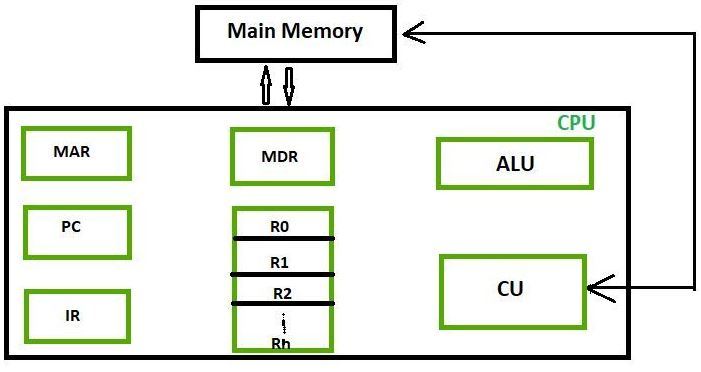
These are classified as given beneath.
- Accumulator:
This is the most frequently used register used to store information taken from memory. It is in unlike numbers in different microprocessors. - Retentiveness Address Registers (MAR):
It holds the accost of the location to be accessed from retentivity. MAR and MDR (Retentiveness Data Annals) together facilitate the communication of the CPU and the primary memory. - Retention Data Registers (MDR):
Information technology contains data to be written into or to be read out from the addressed location. - General Purpose Registers:
These are numbered as R0, R1, R2….Rn-i, and used to store temporary information during any ongoing operation. Its content tin can be accessed by associates programming. Mod CPU architectures tends to use more GPR so that register-to-register addressing can be used more, which is comparatively faster than other addressing modes. - Program Counter (PC):
Program Counter (PC) is used to keep the track of execution of the program. Information technology contains the retentiveness address of the next instruction to be fetched. PC points to the address of the next instruction to exist fetched from the main retention when the previous instruction has been successfully completed. Program Counter (PC) also functions to count the number of instructions. The incrementation of PC depends on the type of architecture being used. If we are using 32-chip architecture, the PC gets incremented by 4 every time to fetch the next instruction. - Instruction Register (IR):
The IR holds the education which is only nearly to exist executed. The instruction from PC is fetched and stored in IR. As soon as the pedagogy in placed in IR, the CPU starts executing the instruction and the PC points to the next instruction to be executed. - Condition lawmaking annals ( CCR ) :
Condition lawmaking registers contain unlike flags that betoken the condition of any operation.for instance lets suppose an operation caused creation of a negative result or nothing, then these flags are set high appropriately.and the flags are
- Carry C: Fix to ane if an add operation produces a carry or a decrease operation produces a borrow; otherwise cleared to 0.
- Overflow V: Useful only during operations on signed integers.
- Zero Z: Ready to 1 if the result is 0, otherwise cleared to 0.
- Negate N: Meaningful only in signed number operations. Set to i if a negative result is produced.
- Extend Ten: Functions equally a conduct for multiple precision arithmetic operations.
These are generally decided by ALU.
So, these are the different registers which are operating for a specific purpose.

Source: https://www.geeksforgeeks.org/different-classes-of-cpu-registers/
Posted by: brownthishe.blogspot.com
0 Response to "What Kind Of Memory Are The Registers"
Post a Comment