

Realme 8 Vs Redmi Note 10
In March this year, nosotros starting time saw the two new mid-rangers,realme eight Pro and Redmi Notation x Pro. Manufacturers estimated them at well-nigh the same toll, and in terms of the characteristics of the device they turned out to be even too similar in places. In today's textile, nosotros accept a proper head-to-head to determine in one case and for all which one is the all-time.

realme 8 Pro and Redmi Note x Pro past the numbers
| Redmi Note ten Pro | realme eight Pro |
| Display | 6.67′′, AMOLED, 2400×1080 pixels, 20:9 aspect ratio, 395 ppi, 1200 nits, 120 Hz, HDR10 | 6.iv′′, Super AMOLED, 2400×1080 pixels, twenty:ix aspect ratio, 409 ppi, 1000 nits, sixty Hz |
| Chipset | Qualcomm Snapdragon 732G, eight nm, 8-core, Kryo 470 Golden 2×2.3 GHz and Kryo 470 Silver half dozen×1.8 GHz | Qualcomm Snapdragon 720G, 8 nm, 8-core, Kryo 465 Gold 2×2.3 GHz and Kryo 465 Silver half-dozen×1.8 GHz |
| Graphics accelerator | Adreno 618 | Adreno 618 |
| Ram | 6/8 GB, LPDDR4X | 6/8 GB, LPDDR4X |
| Storage | 64/128 GB, UFS two.2 | 128 GB, UFS 2.1 |
| Retentiveness card support | MicroSD | MicroSD |
| Wireless modules | Wi-Fi v, Bluetooth 5.1 (A2DP, LE), GPS (A-GPS), GLONASS, GALILEO, BDS, NFC, IR port | Wi-Fi 5, Bluetooth v.0 (A2DP, LE), GPS (A-GPS), GLONASS, BDS, NFC |
| Chief camera | wide-angle module 108 MP, f/1.9, 26 mm, one/i.52″, 0.7µm, dual pixel PDAF; ultra-wide-angle module viii MP, f/2.2, 118˚, one/4.0″, i.12µm; macro v MP, f/ii.four, AF; depth sensor 2 MP, f/2.4 | wide-bending module 108 MP, f/1.nine, 26 mm, i/1.52′′, 0.7μm, PDAF; ultra-wide-angle module 8 MP, f/2.3, 119 ̊, i/4.0′′, 1.12μm; macro 2 MP, f/ii.4; depth sensor two MP, f/2.iv |
| Front-facing camera | 16 MP, f/2.5, ane/3.06′′, 1.0μm | 16 MP, f/2.5, 1/3.0′′, 1.0μm |
| Battery | 5020 mAh | 4,500 mAh |
| Fast charging | 33 West | fifty W |
| OS | Android 11 with MIUI 12 beat | Android eleven with realme UI two.0 shell |
| Dimensions | 164.0×76.v×eight.ane mm | 160.6×73.ix×8.1 mm |
| Mass | 193 grand | 176 one thousand |
Smartphone versions and price
Oftentimes middle-range smartphones have several modifications with different amounts of RAM and storage. There is absolutely null wrong with this, the approach is understandable, because it allows undemanding users to save a little, and demanding people will non take to worry virtually whether they will have plenty storage. That is, potential buyers take a option – and that'south skillful.
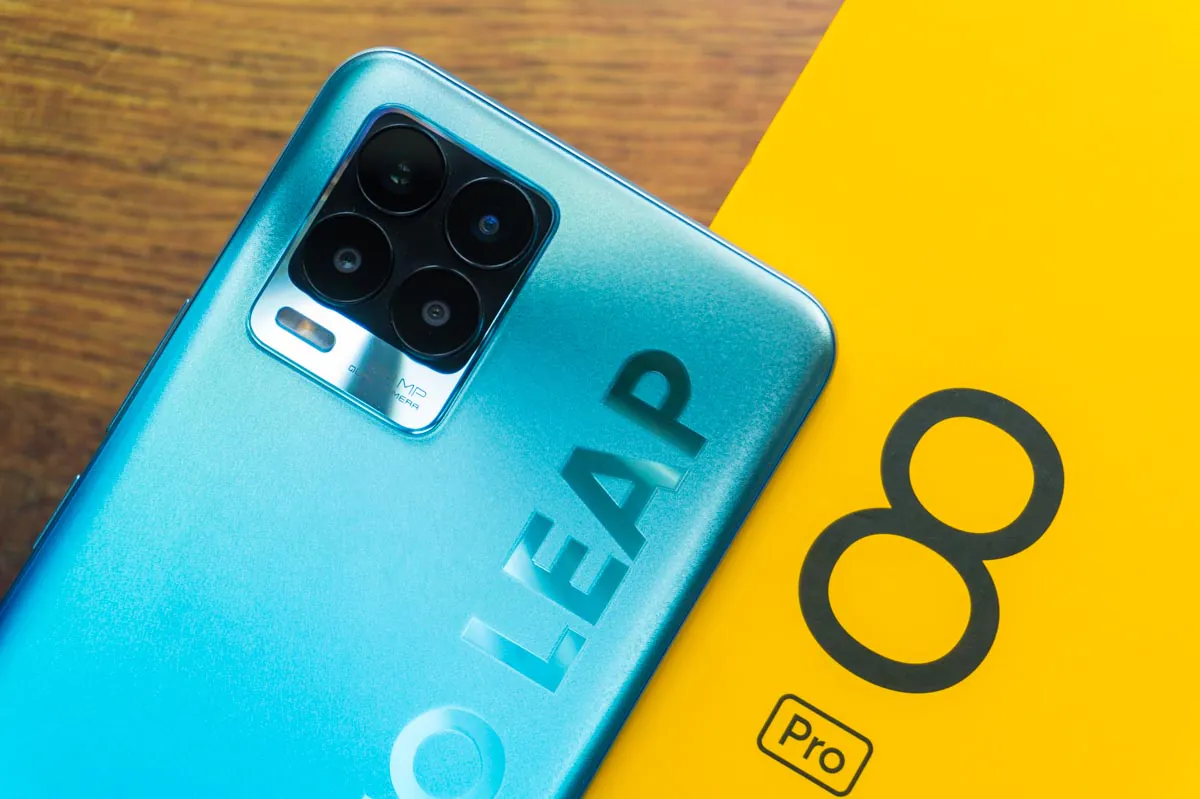
Today's guests were no exception either – both smartphones exist in several versions. In the case of the Redmi Note x Pro, however, this choice is slightly bigger, because the smartphone has as many as iii variants: vi/64, 6/128 and 8/128 GB. The realme 8 Pro has simply two: half dozen/128 or 8/128 GB. Of form, Xiaomi gets a pocket-sized reward here for one simple and understandable reason – there is a basic option and the buyer does not have to overpay for actress gigabytes if they don't need information technology. Still, practise not forget that the availability of certain modifications depends on the region.

In certain European countries Redmi Note 10 Pro is sold in 2 versions, 6/64 and half-dozen/128, for$ 293and $ 329 respectively.
Therealme 8 Pro 8/128 GB costs virtually$ 293.
What'due south in the box
Smartphones come in cardboard boxes of about identical sizes, but information technology is obvious that with different design fit each of the brands. Their contents are identical on the one hand: a smartphone, a ability adapter, a USB Type-C cable, a simple silicone case, a SIM eject tool and documentation. But the cases and, most importantly, the power adapters, are slightly different.
The Redmi instance stands out for its matte back and Type-C port plug, just realme has a much more than powerful power adapter. It is compatible with SuperDart's proprietary fast charging technology and boasts 65W power, while with Redmi comes with a 33W unit. Nosotros'll discuss these differences after.
Read also: Realme GT review: Track-Worthy Smartphone for the Masses
Design, materials and the layout
Both smartphones wait relevant and correspond to all mod trends. Their front panels are fabricated are like, with a front-facing camera embedded in the screen, just the dorsum sides of smartphones in completely different. Both phones have completely flat upper and bottom edges.
As I have already noted, the selfie cameras of smartphones are embedded in their screens, just are in different places. In Redmi Annotation 10 Pro, it is located at the pinnacle center, and in realme eight Pro information technology is located in the upper left corner. In terms of placing, information technology is difficult to single out i smartphone, but still I welcome symmetry more than. Plus the camera notch diameter of the Redmi Note 10 Pro is smaller, but with an additional silver edging that makes information technology more than striking.

The bezels around the screen are similar in width. The thinnest, of course, are left and right, but the upper bezel is a little wider. But the main and near noticeable difference in the bezels is the lower indentation, which is smaller, once again, in the Redmi smartphone.
The blueprint of rear panels can be considered in 2 main aspects: the overall blueprint and the execution of the photographic camera unit. Let'southward start with the first one. We have a pre-auction model with a big vertical glossy inscription "Dare to Leap" on the back, but commercial devices volition lose the slogan. And then we won't talk nearly it as a design element.

The first thing that catches your eye is different material and dorsum panel blanket. In the example of the Redmi Notation 10 Pro we take glossy glass with an shimmering calorie-free The realme 8 Pro likewise has a like effect, but its panel is plastic and slightly crude. The camera unit in both smartphones has four modules and a wink, only they are congenital differently.
Redmi's unit of measurement consists of 2 rectangles with rounded corners: a broad base with inscriptions, flash and light amplification by stimulated emission of radiation focus window, likewise as a narrow rectangle with all four modules in unlike visual edges.

The realme block is a little simpler. It is also a rectangle with rounded corners, simply each module is in a separate round eye on black, and underneath them on the same platform in that location is a wink and inscriptions.

Both are visually interesting in their own manner, but with nuances. Wiping the Redmi Note 10 Pro camera unit of measurement is easier simply considering it'due south solid, and the realme eight Pro cameras practise not protrude every bit much. This is too important, especially if you utilise a smartphone without a protective example.

The Redmi Note 10 Pro is made of more than interesting materials and is likewise protected from dust and splashes according to IP53 standard, which is very welcome. Information technology uses hardened Corning Gorilla Glass five at the front and back, and a plastic edge around the perimeter. It collects fingerprints similar crazy.

The materials of the realme 8 Pro case do not stand out much: it has glass just at the front, and the frame and back panels, I echo, are fabricated of plastic. But the latter have more practical coating. Especially the dorsum panel, which not only has a good result on the grip of the smartphone in the hand, just also inappreciably gets dirty.

The color of the case in both cases is three pieces each. The Redmi Annotation x Pro comes in gray, blue and bronze, and the realme 8 Pro can exist blackness, blue and yellow.

The elements are arranged the usual manner. On the right are ability and volume buttons, on the left is a triple slot for two nanoSIM cards and microSD, both have a 3.5 mm sound connector and USB Type-C. The Redmi stands out for two additional elements on the height end: an infrared port and a full-fledged second multimedia speaker. There is no 2nd speaker, much less an infrared port in the realme.
Read also: Xiaomi Mi 11 Ultra review: Powerful Flagship to Close Up the Skeptics
Ergonomics
The size of smartphones differs and the Redmi Note 10 Pro, due to the slightly larger size of the display, is wider than the realme 8 Pro: 164.0×76.5 mm compared to 160.6×73.9. Also, the Redmi Note ten Pro is heavier for a number of reasons and weighs 193 thou, while the weight of the 8 Pro is 176 thou. Only the thickness of the devices is the same – eight.1 mm. I recollect it'south quite obvious that it'south more comfortable to apply the realme smartphone.

In addition to its size, it has a more practical and sturdy torso. Simply at the same time, information technology would be incorrect to scold the Redmi Annotation 10 Pro for its size, because it's just unlike. The big screen has its advantages: it is more pleasant to view multimedia content, play games and read. In return, you accept to sacrifice the comfort of using your smartphone on the go or with 1 manus.

The location of the elements is similar. In that location is no demand to accomplish for physical control buttons, considering they are placed at a user-friendly summit in both cases. With the realme 8 Pro it volition take some time to become used to the relatively low location of the in-screen fingerprint scanner.
Displays of the realme eight Pro and the Redmi Note ten Pro
The displays of smartphones are, of class, dissimilar and at the same time they are quite different. The size of the Redmi Notation x Pro screen is slightly larger, the matrices of both are active on organic LEDs, only the realme has Super AMOLED, non a unproblematic AMOLED. Still, it is unlikely that this will be any decisive factor for the end user. Much more important are their other features: peak brightness, refresh charge per unit and touch on sensitivity, all of which are improve in the Redmi Note 10 Pro. From the similarities, we can merely notation the resolution and the attribute ratio.
| Smart phone | Redmi Notation 10 Pro | realme viii Pro |
| Display size | 6,67″ | 6,4″ |
| Matrix type | АМОLED | Super AMOLED |
| Resolution | 2400×1080 pixels | 2400×1080 pixels |
| Pixel density | 395 ppi | 409 ppi |
| Attribute ratio | xx:nine | twenty:nine |
| Top brightness | 1200 nits | 1000 nits |
| Frequency | 120 Hz | 60 Hz |
| Bear on reading frequency | 240 Hz | 180 Hz |
| Other | Back up for HDR10 technology | Congenital-in fingerprint scanner |
What tin I say about screens? They are both skilful in terms of brightness, dissimilarity and saturation. Amidst the obvious differences, nosotros tin can note the colder tones in the realme viii Pro, only this is not a trouble. In the settings information technology is possible to suit the color temperature of the display based on personal preferences. The maximum effulgence level is slightly higher for the Redmi smartphone, but on a sunny solar day, the information is read usually from both smartphones.
In general, the difference betwixt screens is quite difficult to observe when used normally. The viewing angles are equally wide, but both with typical pink and green tones of white color at certain angles. Every bit for colour reproduction in full general, information technology can also exist adjusted in both cases and made either calm or more saturated, every bit befits archetype AMOLED panels.
Mayhap the biggest con of the realme 8 Pro display compared to the Redmi Notation 10 Pro is its refresh rate, 60 Hz, while Redmi boasts 120 Hz back up. Naturally, the Note 10 Pro will exist preferable in this regard. The UI on the latter is noticeably smoother, it is more than pleasant to look at various animations and apps that support 120 Hz.

The touch reading frequency is besides college for Redmi, 240 Hz, but realme has not forgotten about mobile gamers and provided their smartphone with a sampling rate of 180 Hz. Among other features of the Notation 10 Pro display there's support for HDR10, but an optical fingerprint scanner has been built into the realme 8 Pro screen, which we will talk nearly in the future.

Elsewhere, everything is similar to the residue of the available settings. There are calorie-free/dark organization themes, a blue filter and other familiar parameters. Separately, it is worth noting the Always On Display function. It is bachelor in both smartphones, but the customization capabilities are much greater in the MIUI shell on the Redmi smartphone.
This is a broad range of different dials (analog, digital, with image) and the power to modify the styles and colors of these very dials. What's in realme? You tin remove the display of the date, notifications and battery level. Maybe other dials will be added with updates, merely so far this is.
Read also: Realme Watch S Pro review: Waterproof, with GPS and AMOLED, merely is it plenty?
Performance of the realme 8 Pro and the Redmi Annotation 10 Pro
Now, the hardware. It is like in smartphones: these are 8-nm chipsets from Qualcomm, which include 8 cores with the same maximum clock speeds up to 2.iii GHz for two loftier-performance cores and upward to 1.8 GHz for the other six. However, the processor cores themselves are dissimilar: the Redmi Note 10 Pro with the fresher Qualcomm Snapdragon 732G has Kryo 470 cores, and the realme 8 Pro based on Snapdragon 720G with Kryo 465 cores. Graphic accelerator in both is Adreno 618, but its frequency is college for the 732G. That means that Redmi is ameliorate at performance, which is confirmed past the results of smartphone testing in the benchmarks.
Even so, practise not immediately write off realme 8 Pro accounts. Firstly, the divergence is really pocket-size, and secondly, the overall implementation of the chipset is more successful in the realme smartphone. It heats up less. For case, you tin can have a throttling test, where CPU functioning decreases by merely 10% in fifteen minutes, while the Redmi Notation ten Pro loses 30%. Y'all can also pay attention to the performance values in GIPS.
The corporeality of RAM in smartphones, as I mentioned earlier, can be 6 or 8 GB, the type of memory is LPDDR4X. Today, half-dozen GB of RAM is enough for a mid-ranger.

The realme 8 Pro received a 128 GB drive, and the Redmi Note ten Pro, depending on the modification, can be equipped with either 128 GB or 64 GB in the basic version. We take devices with 128 GB of storage, of which 107.06 GB is bachelor for the user in Redmi and 107.99 in realme. But the storage itself is a little faster in the starting time one since information technology'southward UFS 2.2, while the 2nd has UFS 2.i. Storage can be extended by installing a microSD memory card; thankfully, none of the smartphones ask you to sacrifice a second SIM bill of fare.

Smartphones are fast in utilise and tin can run whatever you throw at them. When comparing direct, you can feel the Redmi Note 10 Pro smoother due to a screen with a refresh rate of 120 Hz and other animations. But if you are non used to the increased refresh charge per unit, realme will definitely non disappoint you lot with its smoothness and speed.

Interestingly, in resources-intensive games, the realme 8 Pro smartphone shows a slightly higher average FPS. The difference is not actually critical and in Phone call of Duty: Mobile at loftier graphics settings differs by 2-3 fps, although in Shadowgun Legends on the same high chart the difference is 5 FPS in favor of realme. Both smartphones allow you to play any titles and ofttimes even on high or fifty-fifty maximum graphics, although, of form, at that place are exceptions. GameBench software was used for measurements:
| Smartphone | Redmi Note 10 Pro | realme 8 Pro |
| Call of Duty: Mobile (very high, all furnishings except reflections on the water are agile) | 54 | 56 |
| PUBG Mobile (high, active smoothing and shadows) | xxx | 30 |
| Shadowgun Legends (high, frame rate: 60) | 47 | 53 |
Read also: Xiaomi Mi 11i review: the most affordable flagship on Snapdragon 888
Cameras of the realme 8 Pro and the Redmi Notation 10 Pro
In this section, we volition talk about the photo and video capabilities of 2 smartphones. The primary unit of cameras of both devices consists of four modules: the primary wide-angle, boosted ultra-wide-angle, additional module for macro and auxiliary depth module. The tabular array below shows their main characteristics:
| Smartphone | Redmi Notation 10 Pro | realme 8 Pro |
| Wide-bending module | 108 MP, f/one.ix, 26 mm, one/one.52′′, 0.7μm, dual-pixel PDAF | 108 MP, f/ane.9, 26 mm, 1/1.52′, 0.7μm, PDAF |
| Ultra-wide-angle module | 8 MP, f/2.2, 118 ̊, 1/iv.0′, one.12μm | eight MP, f/2.3, 119 ̊, 1/4.0′, 1.12μm |
| Module for macro | 5 MP, f/2.iv, AF | 2 MP, f/two.4 |
| Depth module | 2 MP, f/ii.four | 2 MP, f/ii.4 |
The main wide-angle module in smartphones is identical – it is Samsung ISOCELL HM2. Except that the Redmi Note 10 Pro is equipped with a dual pixel PDAF laser autofocus organisation, while the realme 8 Pro is equipped with a regular phase PDAF. In practice, it turns out that the Note ten Pro focuses a petty faster and more accurately than the 8 Pro.

The chief realme 8 Pro and Redmi Notation 10 Pro wide-angle modules have 12 MP resolution, and the full 108 MP is available on devices as a separate way. It can be used to shoot some landscapes or other scenes with a lot of small details. Such photos will expect clearer and more detailed than in normal resolution.
All photos in today's comparison were taken automatically, with HDR turned off and without AI. More examples of the pictures and all those used in comparing below can be found in the Google Bulldoze binder. Photos from realme viii Pro are saved with the name of the format IMGXXXXXXXXXXXXXXXXXXXXXXXX, and the Redmi Note 10 Pro photos have names similar this: IMG_XXXXXXXXXXXXXXXXXX.
First, permit'due south look at several pairs of photos taken on smartphones in 108 megapixel way. The realme 8 Pro has cooler tones, while the Redmi Annotation 10 Pro makes photos with warmer colors. Both phones accept bug with the white rest. However, the realme eight Pro makes more than detailed pics, which is undoubtedly expert. However, they are oversaturated, and the Note ten Pro has better colors. Too, if you lot pay attending to the sky, Redmi did better with the clouds.
On the 2nd pair, the situation with the white balance repeated itself and the realme 8 Pro again fabricated "colder" photos, with the colors that are unnaturally oversaturated, but the clarity of this moving picture is slightly higher. The Redmi Note 10 Pro has more than natural color rendering.
Now let's discuss the usual shooting manner on the principal wide-bending camera in 12 MP resolution. The starting time example is a tennis court. Predictably, realme has overdone it with the colors again – it looks oversaturated, and the white edge of the grid in the picture looks well-nigh regal. The Redmi, again, is more natural, and there volition be more than information in the shadows. The detail is more often than not the same, I tin can't single out whatever one smartphone in this regard.
At present permit's discuss the usual shooting style on the main wide-angle camera in 12 MP resolution. The offset instance is a tennis court. Predictably, realme has overdone it with the flowers once again – the coating of the site looks oversaturated, and the white border of the grid in the movie looks nigh purple in this picture. The frame with Redmi, once more, is more than natural, and there volition be more information in the shadows. The detail is by and large the same, I can't single out any 1 smartphone in this regard.
At present, here Redmi takes a more natural photo without oversaturated tones, and realme produces more saturated colors. Everything is very similar in detail again, but the sky is weak in both photos.
Let's look at the example taken in portrait style with blurred background. I like blurring better on my Redmi smartphone. Firstly, it did non blur the area with the Sony logo on the camera, as the kickoff smartphone did, and secondly, it blurred effectually the wooden bench more carefully.
Photos in dark mode are near the same. Both are relatively bright, with like detail and well-nigh complete absence of whatsoever obvious digital noise. Color reproduction, as usual, is saturated with the case of realme 8 Pro. The latter also has advanced night manner, where you can manually gear up all parameters by ISO type, white balance shutter speed and focus to provide even better results at night.
Realme also has a cunning technology chosen In-Sensor Zoom, thanks to which, co-ordinate to the manufacturer, the smartphone shoots with a 3X digital zoom at the level of optical 3X zoom. To do this, 8 shots are glued together and after processing a sharper photo is obtained. Redmi has nothing like that, and if you compare the 3X digital zoom on these two smartphones, you get sharper shots on the realme 8 Pro. And all of a sudden, less saturated. Anyway, examples below.
We move from the main wide-angle to the ultra-wide-angle photographic camera. Alas, I have nothing to add here, and then I repeat: realme ever embellishes reality, different Redmi. The detail is better in places on the Notation 10 Pro, the angle of the latter likewise seems slightly wider, although it has 118° in characteristics and the viii Pro has 119°. Alas, both ultra-wides mistiness decently at the edges and cannot avowal of good results in low light conditions. In the gallery below there are several examples at once, and it makes no sense to analyze each i, for the reason stated before.
There's still a camera for the macro. If earlier smartphones showed similar quality results, admitting with a significant difference in color reproduction, the images in macro mode will exist radically different in all key parameters. The module itself is more interesting in the Redmi Note 10 Pro due to its higher resolution and autofocus. Beneath is a uncomplicated case with a cone, where realme has to maintain a long distance between the lens and the subject of shooting, and Redmi tin be brought near closely. I'm not talking almost colors anymore – on realme eight Pro they're some pale and with a foreign purple shade.
You tin play effectually with the macro module on the Redmi, and get more or less normal photos in daylight, merely the 2d phone 1 is unlikely to exist able to take a good picture. Beneath is another instance.
Video recording is available in 4K at 30 FPS. By default – without whatsoever stabilization, just yous can enable electronic ane in the standard app. It just scales the image a little to reduce shaking, so the viewing angle with stabilization will be noticeably smaller than without it. Examples in total resolution with stabilization off – below.
realme eight Pro:
Redmi Note 10 Pro:
The ultra-wide-angle module can tape video in 1080P and 30 FPS resolution. By default with stabilization, merely in this instance information technology performs worse on the realme eight Pro smartphone – the picture floats. Although one that the other is generally shooting video on the ultra-wide is quite average.
realme eight Pro:
Redmi Note 10 Pro:
Front end-facing cameras are 16 MP, with the same viewing angle. Both are filmed quite usually, simply the better details are on the realme 8 Pro. And, of course, there was a slight embellishment of colors. Video is shot in a maximum 1080P with xxx FPS, just Redmi has a problem: the consequence of a rolling shutter. realme doesn't have it.
The photographic camera apps are advanced and have many different shooting modes both for photo and video. For case, both have full manual modes with the ability to relieve photos in uncompressed RAW format.
Document shooting modes, panoramas, simultaneous shooting on the main and selfie cameras, as well as a whole scattering of video recording modes: accelerated, ho-hum, with manual pick of parameters and other effects.
Unlocking
The methods of unlocking smartphones are the same, but the technologies used vary from device to device. First of all, face recognition, information technology is equally implemented via front-facing cameras. Regarding the speed of performance, information technology is besides difficult to single out one gadget, as both of them have fast recognition. Although due to fundamentally different unlocking animations, it seems that realme 8 Pro is faster. But again, both fast recognize the possessor almost instantly during the day and in general, but in low low-cal they tin fail.

The Redmi Note 10 Pro is better in bad lighting conditions. All the same, Redmi does non know how to increase the brightness of the screen for additional facial illumination, unlike realme. The latter has such an option, it can be activated and then it is quite possible to unlock the smartphone face even in pitch darkness, where the second smartphone volition be powerless. But under normal conditions they are nigh the aforementioned.

Now nearly fingerprint scanners. They are also present in both devices, but as noted earlier, they differ in technology. The Redmi Note 10 Pro uses a classic capacitive fingerprint scanner that is mounted in the power push button. And what'due south especially nice is that the button actually looks like a regular key. No recessed notch with an elongated apartment platform and everything else – but a relatively big button, the entire surface of which reads the fingerprint.

But in the realme 8 Pro we have a more than mod and relevant engineering that migrated to mid-rangers in the last generation with the realme 7 Pro. That is, the scanner is built straight into the screen (or under the screen, if yous like). Its type, every bit in most other smartphones, is optical with traditional bright finger illumination when practical to the scanner.

It'due south non actually that easy to determine which option is better. On the one hand, I would like to praise realme for introducing modern technology in a centre-range smartphone, merely at the same time scold information technology for the depression position of the surface area itself. Plus, it should exist understood that it volition take some time to go used to such a scanner.

With a standard capacitive scanner, it's much easier in Redmi. First of all, information technology has a amend location, which yous do not demand to become used to, considering your finger itself lies on the button on the side when you accept your smartphone in your hand. Secondly, such scanners are mostly platonic in terms of stability and work almost unmistakably. That is, the smartphone will non only unlock faster, only is besides more than stable.

Equally a result, the standard fingerprint scanner in Redmi Note ten Pro has slightly more than advantages over the trendy in-screen scanner in the realme 8 Pro. Although in practice, I have no serious comments on either the beginning or the second. They both work well, merely the Annotation x Pro is faster.
If you unlock the phone past touch on, not by pressing the button, information technology's much faster. Because in the 2d instance, there'southward a filibuster.In the optical scanner settings in 8 Pro at that place is a selection of blitheness during scanning, displaying an icon on the deactivated screen and running an app when applying a certain fingerprint.
realme 8 Pro and Redmi Notation 10 Pro: battery life
We accept smartphones of different sizes and information technology is quite anticipated that they will also have different capacity of built-in batteries. The Redmi Annotation ten Pro is equipped with a 5020 mAh battery, while the realme viii Pro has a 4500 mAh battery. And with battery life, the state of affairs is cryptic, because that difference in volume is partially offset by a slightly larger brandish of Redmi, for case.

Several methods were used for more than objective comparative battery tests: watching video for 30 minutes with maximum display effulgence, 30 minutes in Shadowgun Legends at the maximum brightness and a Work 3.0 operating time test in the PCMark benchmark, which simulates normal use, also at maximum brightness.
What happened in the end? In the starting time exam, the Redmi Annotation ten Pro lost 5% of the charge in one-half an 60 minutes on YouTube, and the realme 8 Pro lost simply two%. Just in a rather resource-intensive game, both devices lost nine% battery power each. In PCMark Work 3.0, the commencement smartphone lasted ix hours and 7 minutes, and the 2d smartphone lasted 9 hours and half dozen minutes. Therefore, it's about the same when it comes to the battery life, and in real use both smartphones will bear witness themselves very well and can be counted on a day of work provided that yous use it is very intensively and 1 and a half or ii if y'all do not play games.
As I noted at the showtime of our comparing, smartphones come with ability adapters of different ability: 33 W with the Redmi Note 10 Pro and 65 Westward with the realme 8 Pro. Both devices support fast charging, merely it is important to analyze that in the case of a realme smartphone it will be limited to 50 watts.

It is articulate that batteries of dissimilar sizes and adapters are as well different, but information technology will take only 50 minutes to fully charge the realme eight Pro from 0 to 100%, while the Redmi Note x Pro will charge for 1.five hours. I retrieve y'all will hold that the difference of forty minutes in the charging process is much more significant, given that there is parity between smartphones in battery life. So the winner in this fight is unconditionally the realme 8 Pro.
| Smartphone | Redmi Note ten Pro | realme 8 Pro |
| 00:00 | 0% | 0% |
| 00:x | 15% | 28% |
| 00:20 | 32% | 53% |
| 00:30 | 47% | 72% |
| 00:40 | threescore% | 90% |
| 00:50 | 69% | 100% |
| 01:00 | 79% | |
| 01:x | 88% | |
| 01:twenty | 94% | |
| 01:30 | 100% |
Audio and wireless modules
The earpiece speakers in both devices are normal and perform their main part well.. But if we talk virtually multimedia playback, the Redmi Note ten Pro deserves praise here. The reason for this is simple – it has a second full-fledged multimedia speaker on the top (not to be dislocated with an earpiece speaker) in addition to the lower one. The advantages of this solution are obvious: total stereo, louder audio with decent quality for your class. The realme eight Pro has nothing to offer here.

In addition, Redmi has diverse features: Dolby Atmos with four profiles to cull from, a full-fledged graphic equalizer with presets and custom settings, non to mention split up audio parameters for headphones. In realme, of these things, just Real Sound technology with four like profiles is available.

Everything is like in wireless modules. Smartphones can piece of work in 4G networks, support five GHz Wi-Fi range (Wi-Fi 5), are equally expert "friends" with Bluetooth devices, although the versions are slightly different: Note ten Pro supports five.1, and 8 Pro supports 5.0. Navigation modules besides piece of work accurately, although in addition to GPS/A-GPS, GLONASS and BDS, Xiaomi as well has GALILEO support. Chiefly, the devices accept received popular NFC modules for contactless payment. But the Redmi Note 10 Pro has another trump card – an IR port for managing household appliances.
Read also: Realme 7 5G review: Mid-Ranger with 5G support
Firmware and shells
Both smartphones run on the latest version of Android 11, but naturally with very different shells: MIUI version 12.5 is installed on the Redmi smartphone, and the realme UI 2.0 is installed on the realme device. They have little in common in terms of UI, but sometimes there is similar functionality.
For case, game hubs with similar functions, a number of identical gestures, 2 methods of arrangement navigation with full gestures or three regular buttons and a decent number of visual customization tools. Each vanquish has pros and cons. They're both skilful in their own style, so we probably won't choose the all-time one.
Verdict
The advantages of the realme viii Pro include a more practical case and compact size, stable hardware, a modern in-screen fingerprint scanner and much faster charging. At the same time, the Redmi Note 10 Pro offers more expensive materials, its case is protected from splashes and dust, the display supports 120 Hz, the macro is improve, in that location is a full stereo audio, as well as an infrared port.

But the issue with cameras is ambiguous. Their level is very similar, but as you could run across for yourself, at that place are significant differences in the mail service-processing. The realme 8 Pro takes sharp and saturated photos with which you merely don't demand to do anything. The Redmi Note 10 Pro offers more… counterbalanced pics that can be edited if desired, or non touched at all.

What conclusions tin can be fatigued from therealme 8 Pro and theRedmi Annotation x Pro? Both smartphones are quite good and offer a sufficient number of interesting features for their class.
Read also:
- Sennheiser Momentum True Wireless 2 TWS earbuds review: $360 for what?
- Google I/O 2021: what's new in the world of Android
Subscribe to our accounts:
- Google News
- YouTube

Realme 8 Vs Redmi Note 10,
Source: https://root-nation.com/en/gadgets-en/smartphones-en/en-realme-8-pro-vs-redmi-note-10-pro/
Posted by: brownthishe.blogspot.com
0 Response to "Realme 8 Vs Redmi Note 10"
Post a Comment